Research
AI agents, EHR foundation models, spatial and single-cell omics, and integrative genomics.
I develop AI agents and foundation models at the intersection of computational biology and bioinformatics, working across spatial omics, genetics, and clinical data.
AI Agents for Biological Discovery
How can biological interpretations from omics analysis be checked against supporting evidence?
Building agent harnesses for context-aware, evidence-grounded biological discovery.
I design agent harnesses that combine task-specific skills, MCP-connected tools and knowledge sources, custom guardrails, and bounded repair loops driven by validation. The workflows adapt to cell and tissue context, with biological interpretations checked against supporting evidence.
Explore related software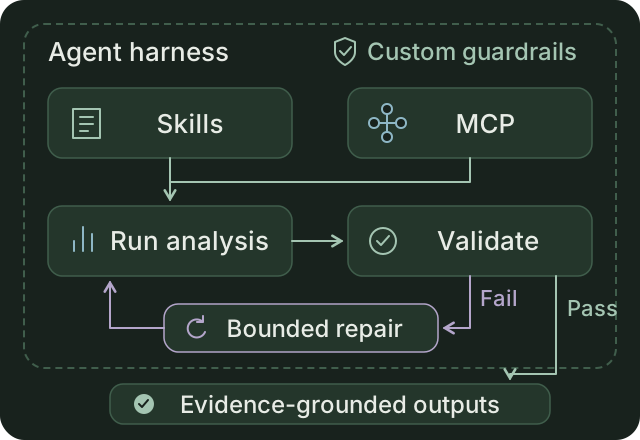
Foundation Models for Electronic Health Records
How can we learn shared clinical representations from notes and structured EHR data?
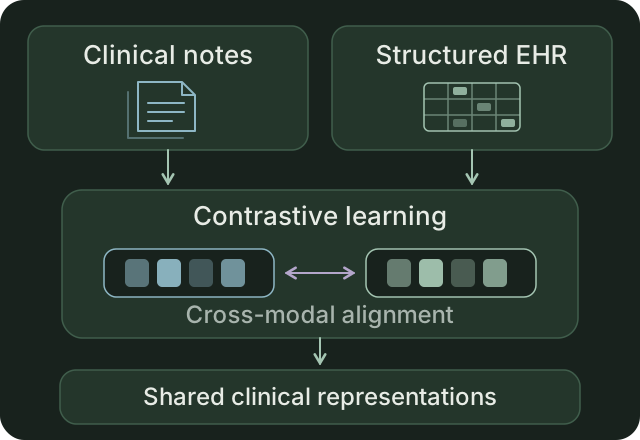
Building clinical foundation models by aligning clinical notes and structured EHR data through contrastive learning.
Clinical notes provide narrative context, while structured EHR data capture clinical measurements and events. I use contrastive learning to connect these complementary views and learn shared clinical representations.
Spatial & Single-cell Omics
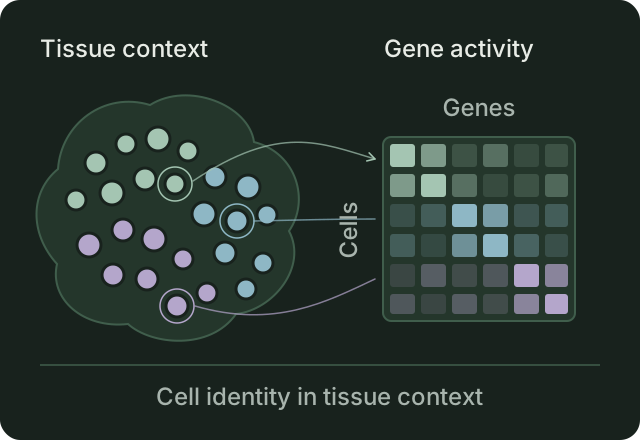
How do cell states and genetic effects vary across tissue regions?
Developing computational tools for spatial omics and single-cell eQTL data.
I am interested in methods that connect molecular measurements to cell states, tissue context, and regulatory variation, building on my experience with functional genomic data.
Integrative Genomics
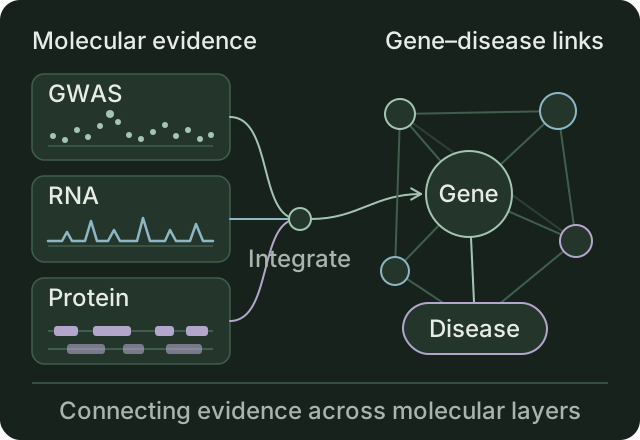
Which genes and molecular processes link genetic variation to complex disease?
Combining GWAS, QTL, transcriptomic, proteomic, and multi-omics data to study disease mechanisms.
I bring together doctoral training and postdoctoral work on TWAS, GWAS, WES, and multi-omics association studies to study complex traits and diseases.
Several of these directions are supported by reusable software and analysis tools. See the software page for current projects.