AI Agents for Biological Discovery
Building agent harnesses for context-aware, evidence-grounded biological discovery.
Learn more about AI Agents for Biological DiscoveryAI × Bioinformatics × Computational Biology
Building AI agents and foundation models for spatial omics, genetics, and clinical data.
I study how AI can learn from molecular and clinical data, connect scientific evidence, and generate testable hypotheses about human disease.
Research directions
Building agent harnesses for context-aware, evidence-grounded biological discovery.
Learn more about AI Agents for Biological DiscoveryBuilding clinical foundation models by aligning clinical notes and structured EHR data through contrastive learning.
Learn more about Foundation Models for Electronic Health RecordsDeveloping computational tools for spatial omics and single-cell eQTL data.
Learn more about Spatial & Single-cell OmicsCombining GWAS, QTL, transcriptomic, proteomic, and multi-omics data to study disease mechanisms.
Learn more about Integrative GenomicsSelected work
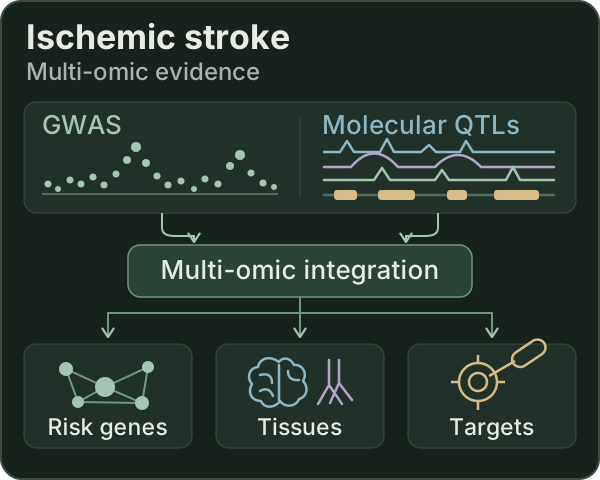
Integrated ischemic stroke GWAS with molecular QTL resources across many tissues to prioritize risk genes, regulatory mechanisms, shared traits, and potential therapeutic candidates.
My contributionLed the study narrative, computational analyses, figure development, and manuscript writing.
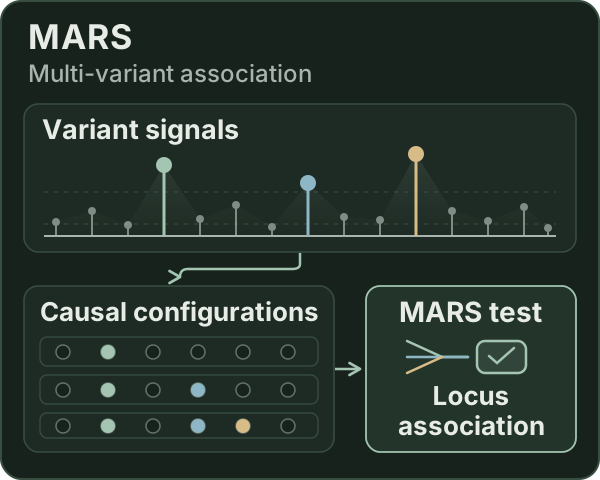
Developed MARS, a summary-statistics association test that models allelic heterogeneity to improve power for detecting risk loci with multiple causal variants.
My contributionPerformed computational experiments to evaluate MARS and co-wrote the manuscript.
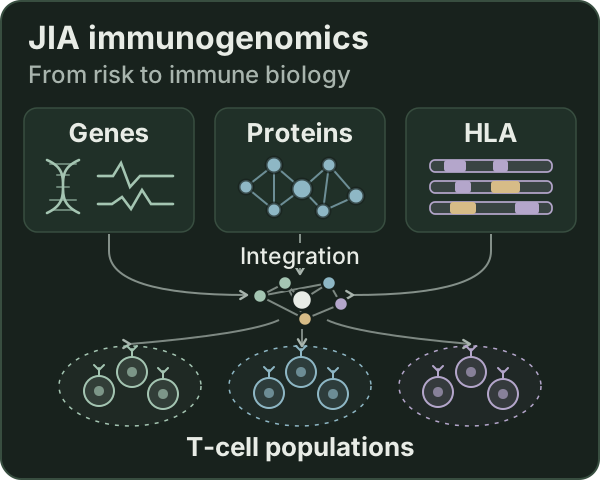
Integrated TWAS, PWAS, genetic architecture, HLA typing, and single-cell immune repertoire analyses to prioritize genes, proteins, and T cell populations associated with juvenile idiopathic arthritis risk.
My contributionCo-designed the study, performed data analyses, and co-wrote the manuscript.
Open-source software
An evidence-guided multi-agent framework for spatial transcriptomics analysis, interpretation, and candidate drug target prioritization.
A self-correcting, SNI-guided RAG system with LangGraph, pgvector, and MCP integration.
An evolutionary reasoning engine that evaluates candidate reasoning with independent, context-isolated LLM judges.
A degree-preserving graph framework for label-free spatial domain identification using frozen biomedical language models.
An R package for a model-based association test that leverages allelic heterogeneity to improve GWAS power.
A macOS menu bar app that converts speech to text using on-device AI.
Along the way
I built SGCP-RAG, a self-correcting, SNI-guided RAG system with LangGraph, pgvector, and MCP integration. Check it out! 🕸️🔁
I built voiceinput for agentic coding and to reduce the typing burden. If you need it, check it out! 🚀🎙️
Finally, the Large-scale integrative analysis of juvenile idiopathic arthritis for new insight into its pathogenesis have been published in Arthritis Research & Therapy! 
WOWOW!!! The Nature Reviews Neurology features our stroke multiome-wide association study paper! Please check News & Views [pdf] in Nature Reviews Neurology
Interested in research or collaboration?
Let's connect